
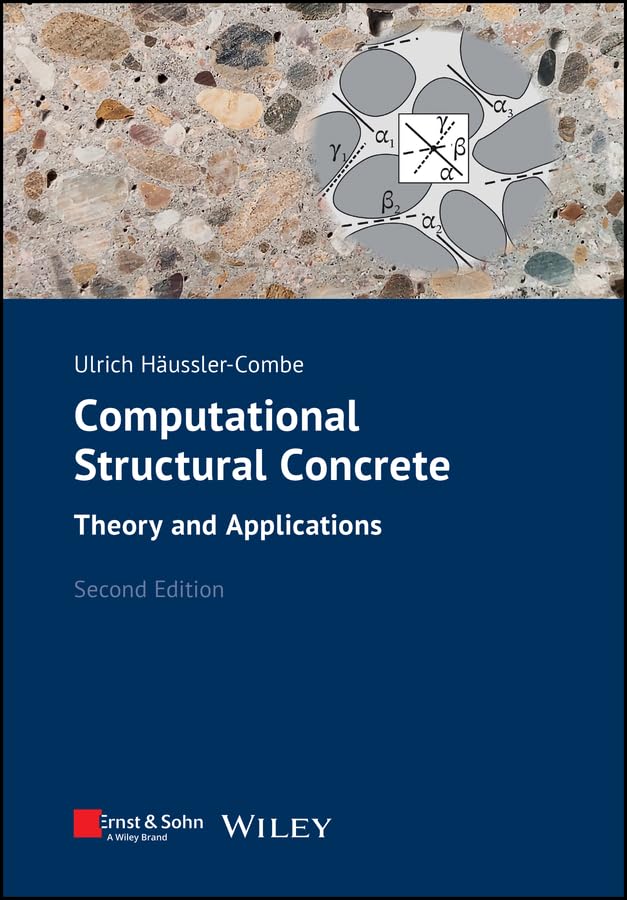
Computational Structural Concrete: Theory and Applications
Product details
| Management number | 231929111 | Release Date | 2026/06/18 | List Price | US$26.21 | Model Number | 231929111 | ||
|---|---|---|---|---|---|---|---|---|---|
| Category | |||||||||
Concrete is by far the most used building material due to its advantages: it is shapeable, cost-effective and available everywhere. Combined with reinforcement it provides an immense bandwidth of properties and may be customized for a huge range of purposes. Thus, concrete is the building material of the 20th century. To be the building material of the 21th century its sustainability has to move into focus. Reinforced concrete structures have to be designed expending less material whereby their load carrying potential has to be fully utilized. Computational methods such as Finite Element Method (FEM) provide essential tools to reach the goal. In combination with experimental validation, they enable a deeper understanding of load carrying mechanisms. A more realistic estimation of ultimate and serviceability limit states can be reached compared to traditional approaches. This allows for a significantly improved utilization of construction materials and a broader horizon for innovative structural designs opens up. However, sophisticated computational methods are usually provided as black boxes. Data is fed in, the output is accepted as it is, but an understanding of the steps in between is often rudimentary. This has the risk of misinterpretations, not to say invalid results compared to initial problem definitions. The risk is in particular high for nonlinear problems. As a composite material, reinforced concrete exhibits nonlinear behaviour in its limit states, caused by interaction of concrete and reinforcement via bond and the nonlinear properties of the components. Its cracking is a regular behaviour. The book aims to make the mechanisms of reinforced concrete transparent from the perspective of numerical methods. In this way, black boxes should also become transparent. Appropriate methods are described for beams, plates, slabs and shells regarding quasi-statics and dynamics. Concrete creeping, temperature effects, prestressing, large displacements are treated as examples. State of the art concrete material models are presented. Both the opportunities and the pitfalls of numerical methods are shown. Theory is illustrated by a variety of examples. Most of them are performed with the ConFem software package implemented in Python and available under open-source conditions. Read more
| ASIN | B0BGB7HGTS |
|---|---|
| XRay | Not Enabled |
| ISBN13 | 978-3433610244 |
| Edition | 2nd |
| Language | English |
| File size | 29.4 MB |
| Page Flip | Enabled |
| Publisher | Ernst & Sohn |
| Word Wise | Not Enabled |
| Print length | 429 pages |
| Accessibility | Learn more |
| Publication date | September 22, 2022 |
| Enhanced typesetting | Enabled |
Bestseller ranking
Seat Cowls



Customers who viewed this product also viewed
Structural


Correction of product information
If you notice any omissions or errors in the product information on this page, please use the correction request form below.
Correction Request Form